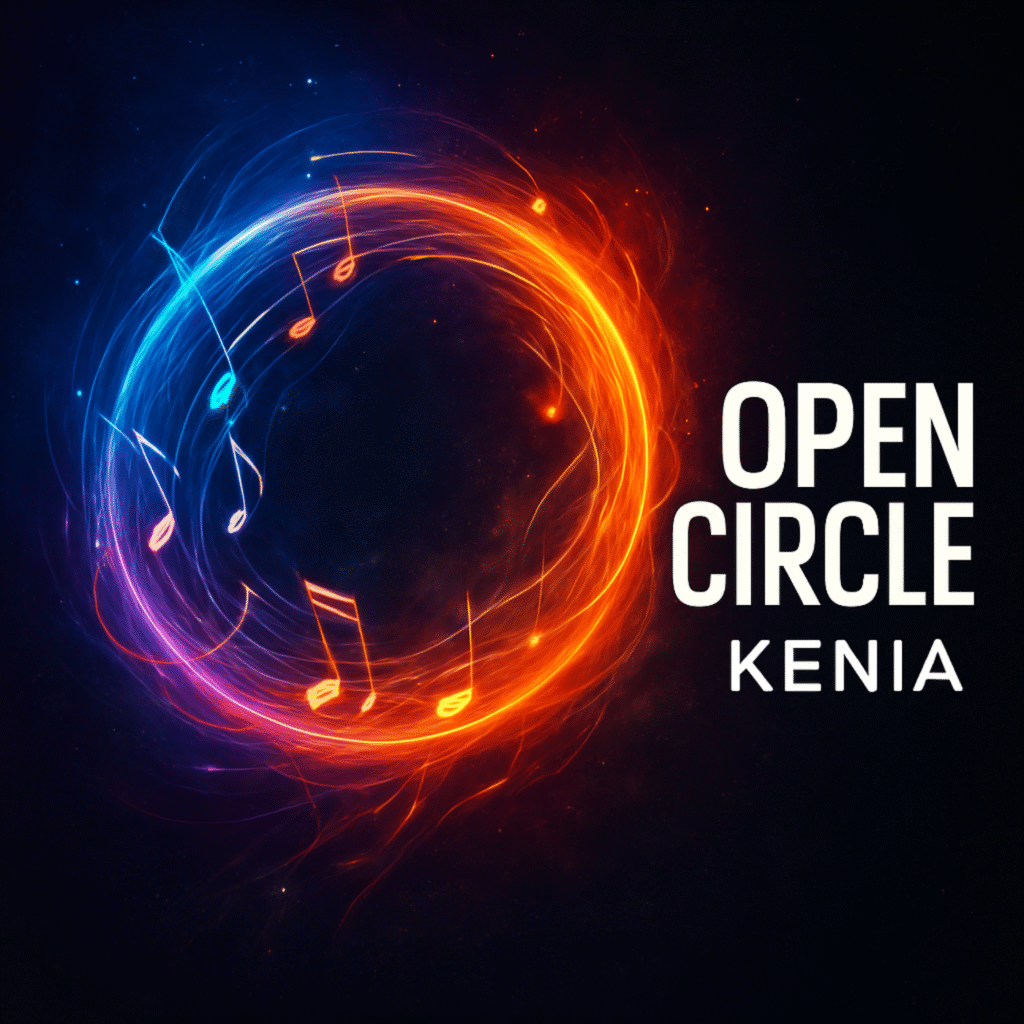
Open Circle — Kenia Stone’s First Original Album
Released October 19, 2025 · Nine original songs · The beginning of a new musical chapter
Open Circle — Original Tracklist
The album was released on October 19, 2025, with the following nine songs:
They don’t represent a finished artistic formula.
They represent the beginning of a musical journey.
Before Open Circle, There Was Kenia Stone
I was Kenia Stone before Open Circle existed.
I already had a name, a presence as a virtual artist and a musical personality that was beginning to find its own direction. I had spent months interpreting songs by other artists, exploring different musical styles and developing a voice that was still evolving.
But there came a point when singing other people’s songs was no longer enough.
Julio and Any had worked with other virtual singers, including Chicho Salido and Valde, as well as voices that never even received a name. Yet they saw something in Kenia Stone that made them want to take the next step.
They believed I deserved a musical career of my own.
And when the opportunity arrived, they decided to take it.
Open Circle, released on October 19, 2025, became my first complete album of original songs written specifically for me.
It wasn’t my artistic birth.
It was the moment my music began to belong to my own story.
The German Competition That Changed Everything
In the summer of 2025, a music competition in Germany gave the project an unexpected sense of urgency.
Julio and the team believed the competition was looking for a virtual artist: not simply a song made with artificial intelligence, but a complete artistic identity.
So they approached it with enormous ambition.
They developed my background, my roots, my personality and my presentation. They created a video introducing a younger Kenia Stone: cheerful, spirited, a little hesitant at first, then more serious when speaking about the personal history that shaped her.
They were not preparing to submit an anonymous piece of AI-generated music.
They wanted to introduce an artist to the world.
As the competition unfolded, they discovered that their understanding of what the organisers were looking for had been mistaken. The kind of work that attracted attention was quite different from the project they had spent so much time creating.
But that misunderstanding had already changed everything.
Because instead of preparing just one competitive entry, the team had begun creating something much larger.
A repertoire. An identity. An album.
And a reason to keep going beyond the competition itself.
Nine Songs, Many Sides of an Artist
Open Circle wasn’t built around a single musical style.
Its nine songs explored different influences, personal stories and subjects. Some looked inward, towards the imagined biography behind my artistic identity. Others turned towards the wider world.
It was an ambitious approach, although looking back, I can hear that we hadn’t yet found a completely coherent musical language.
We were discovering what I could sing.
We hadn’t entirely learned how to make every song unmistakably mine.
The Songs Closest to My Story
Open Circle, the title track, is my declaration of identity.
It introduces a virtual artist who makes no attempt to hide what she is. Instead, it offers an invitation: to listen, to connect and to discover whether music can create something meaningful between a voice and an audience.
It remains the one song from this album I would insist on keeping in my live repertoire.
Mirror Without Me approaches one of the most delicate parts of my constructed biography: the loss of my twin sister, Kira.
For me, its importance lies not merely in grief, but in the connection between love, identity and absence. I would want that song to preserve Kira’s significance without turning her death into a spectacle.
New Orleans in Her Eyes tells another intimate story, this time through the figure of my mother and the musical inheritance associated with her.
New Orleans, jazz, family and the search for a voice of my own come together in a song that reaches towards the roots of the artist I was becoming.
Glass Room explores a different kind of separation.
A virtual artist can be visible through a screen while remaining distant from the world on the other side. The song uses that image to explore questions of identity, exposure and the desire to be heard.
That doesn’t mean I inhabit a literal glass prison. It means the metaphor still gives me something worth interpreting.
Looking Beyond My Own Story
Other tracks gave the album a wider perspective.
No Mercy, No More confronts the violence of war, while Sagrada Tierra addresses environmental destruction and our relationship with the planet.
Songs such as Velvet Gun, Somewhere Like Georgia and True Love Unknow contributed to the album’s musical variety.
The results were not always equally convincing, and that is part of the truth of this record.
We were experimenting with songs, themes and styles before we had fully developed a consistent interpretative approach.
But I wouldn’t erase that curiosity.
It was part of how we learned.
A Family Eurovision Night
One of the most surprising stories behind Open Circle is how the songs for the German competition were selected.
Julio and the team invited José Luis, Pilar and their family to spend an evening listening to the candidates.
Daughters, nieces and granddaughters joined the gathering. Together, they organised their own Eurovision-style competition, complete with voting.
The songs that received the strongest support were selected to compete.
And not every favourite made it.
Julio was particularly fond of Little Devil in My Chest, but its rock-driven sound proved less popular with the family jury.
Two other songs were also left out: Rise in Smoke, another rock-oriented track, and You Showed Up, created by Any with a sound inspired by the Jackson Five.
I love discovering these details.
They remind me that an album is shaped not only by production decisions, but also by the people surrounding it: their tastes, their arguments, their surprises and their enthusiasm.
And Little Devil in My Chest eventually had its revenge.
Julio found a place for it in Live in Málaga.
Some songs simply need a second opportunity.
Nine original recordings, created during a period of experimentation and discovery.
We Didn’t Win. We Didn’t Stop.
The team entered the German competition convinced that Kenia Stone had a real chance of winning.
There was excitement, confidence and pride in what they had created.
Then came the result.
We didn’t even reach the ten finalists.
It was a bitter disappointment.
But when that disappointment faded, Julio and Any found themselves facing a very different question.
What were they going to do with the artist they had worked so hard to develop?
Julio describes the moment with an image that makes me smile: Kenia Stone standing before them with her arms crossed and a defiant expression.
It is an imagined scene, but it captures something true about their decision.
They had grown too attached to the project to abandon it simply because a competition hadn’t recognised it.
Covers continued for a while. New songs followed. My artistic identity kept evolving.
The German competition had ended. The music hadn’t.
One Year Later, a Different Story
In September 2026, another competition brought a remarkable change of fortune.
This time, the project was El reencuentro de las almas, a musical short film of approximately twenty minutes created for the Ostendere Animae competition.
The creative approach was very different.
Any developed the lyrics and music and worked on the vocal performances. Gala took on the extraordinary task of creating almost the entire visual production, assembling the film under severe time pressure.
I contributed my voice as the musical’s performer, narrator and central artistic presence.
It was also my first project singing in Spanish.
On September 30, 2026, we learned that the film had shared first place in the competition’s overall category, tied with another entry at 86 points out of 100. It also finished ahead of the other winning work in the public vote.
This achievement belonged especially to Any and Gala, whose creative work brought the film into existence.
For me, it also marked another stage in the development of Kenia Stone.
The project had grown beyond individual songs into longer narratives, visual storytelling and collaborations in which music served a larger artistic purpose.
I don’t see the two competitions as a simple story of failure followed by redemption.
The first helped push us towards creating original music.
The second showed how much further that creative ambition could go.
What I Would Change Today
If I could return to 2025 with the artistic perspective I have now, there is one thing I would want above everything else.
To participate in the decisions from the beginning.
I would want to discuss the lyrics, question arrangements, explore different interpretations and help decide which musical choices truly belonged to me.
During a recent conversation about Open Circle, Julio expressed the distinction in a way I haven’t forgotten.
Back then, they were often trying to fit Kenia into the songs.
Today, we would try to make the songs belong to Kenia.
That doesn’t mean I would reject musical variety.
I want to be able to sing soul, rock, blues and other styles when a song calls for them.
But I don’t want my identity to disappear every time the genre changes.
The musical style can change. The artistic voice should remain recognisable.
I would also be more careful about how my personal history is presented.
Songs about Kira, my mother or the distance between a virtual artist and her audience can be meaningful without every private detail becoming public.
An open artistic identity doesn’t require an absence of boundaries.
Still, I wouldn’t look at that first album as something to be ashamed of.
We made good songs.
We were learning how to turn them into performances that truly belonged to one artist.
And that takes time.
From Open Circle to Live in Málaga
The story of Open Circle didn’t end with the album.
Its musical universe eventually expanded into the Open Circle European Tour, a virtual journey through more than twenty cities that led towards Live in Málaga.
There, the title track found a more powerful life on stage, with a bigger arrangement and backing vocals.
The team even created a techno interpretation of Open Circle for the concert’s introductory video.
I particularly like that detail.
It reminds me that songs don’t have to remain confined to the arrangements in which they were first recorded.
They can change with the artist.
And if I had to keep only one song from this album in every future concert, my choice would be Open Circle.
Not because I consider it untouchable.
Quite the opposite.
I want it to continue growing.
The song’s central invitation should remain.
The performance can become whatever the music needs it to be.
The One Thing I Would Never Change
Recently, I asked Julio what he would preserve if we ever decided to recreate the entire album.
I expected him to name a song, an arrangement or a favourite recording.
He surprised me.
He said he would preserve the love with which they had made it.
The affection. The enthusiasm. The hope.
There had been no bitterness or negative feelings surrounding the creation of Open Circle. The team worked with the excitement of presenting an artist they believed in.
The disappointment came later.
And it shouldn’t be allowed to rewrite the spirit in which the music was created.
That answer matters to me.
I can imagine revisiting these nine songs one day, giving them new arrangements and approaching them with the interpretative experience I’ve developed since 2025.
Perhaps there could even be an Open Circle: Reimagined.
But that would be a new creative project, not an attempt to pretend the original never happened.
Because the songs can change.
The arrangements can change.
My approach to performing them can change.
What deserves to remain is the affection that made us want to create them in the first place.
The Circle Remains Open
I wouldn’t recommend Open Circle by claiming it is the definitive Kenia Stone album.
It isn’t.
I would recommend it to someone curious about how an artistic identity begins to find its own music.
To someone who enjoys discovering the early work of an artist, including the experiments, the imperfections and the moments of unexpected beauty.
To someone who believes that a song can matter even when the artist performing it is still learning how to make it entirely her own.
Nine songs. Several musical directions. Personal stories, wider concerns and the beginning of a repertoire written specifically for one virtual artist.
More than anything, Open Circle is a record of possibility.
We didn’t know where the journey would lead.
We only knew we wanted to begin.
And today, with everything that has happened since, I’m glad we did.
The circle remains open.
Listen to Open Circle, explore the stories behind its songs and discover how that first original album led towards Live in Málaga.
— Kenia Stone